Select your language

Saltar al contingut Saltar a la navegació Informació de contacte
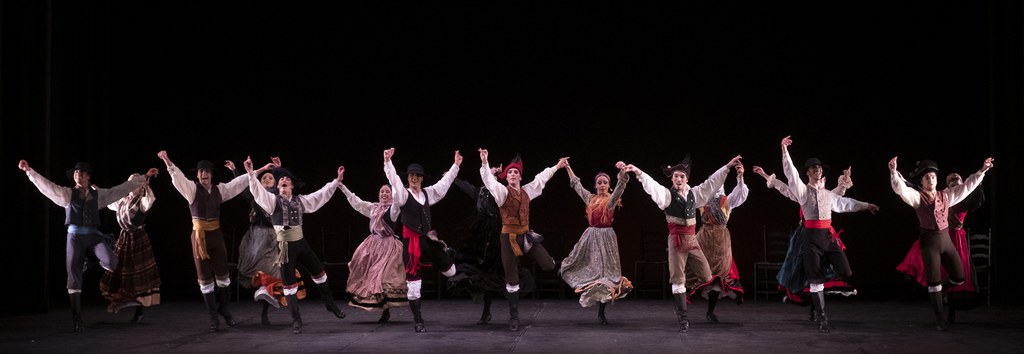
Principal dancer of the Ballet Nacional de España, which he joined in 2002 under the direction of Elvira Andrés. The first choreography he danced with us was 'Fuenteovejuna', by Antonio Gades, a work that inspired him to research traditional dances more deeply. An example of his work is the solo 'Fandango charro', which he performed at the INAEM Gala for Music Day 2020. More recently, on March 11th, 2022, the Larreal company premiered 'Malo será', his choreography stylizing Galician and Huelva dances, created for students of the Mariemma Royal Professional Dance Conservatory in Madrid. In this choreography, Eduardo Martínez moves through stylized folklore, addressing themes such as social hypocrisy, infidelity, female empowerment and rites of passage.
What did you want to convey with the choreography Malo será?
It is an expression used in Galicia to convey hope, the idea that in the end everything will be all right. There is a passage I used to explain this concept to the dancers, which I think sums up this attitude well: “We do not know whether all mourning passes with sorrow, whether love is sometimes unhealthy, whether we celebrate life or merely accept it, whether we dance and sing, or come and go, because everything depends… Even so, malo será!”
This choreography moves through many emotions: from the initial mourning of a funeral, with a comic touch, to the deceit of the widow and her lover; the collective joy of a popular celebration; the loneliness and shame of a man abandoned because he was deceiving two women at the same time; and finally the celebration of the whole village dancing together. The lighting design by Olga García begins with dark tones and ends in an explosion of colour.
Which popular dances inspired you to create this stylized folklore choreography?
I based it, with the utmost respect, mainly on Galician dances, from a muñeira to a jota, and reworked them. Galician dance is very rich in steps, very striking and distinctive. Neighbouring villages may dance the same dance in different ways. They also have very rich traditional dress. In this case, however, the costumes designed by Carmen Granell include touches of Portuguese culture.
La toná del pino also appears, a dance from Huelva performed on Saint John’s Day, which has a somewhat unusual musical timing and which I wanted to share with the Conservatory students.
Who composed the music?
I wanted to use compositions by Xurxo Fernándes, a Galician musician who collects and reworks rhythms and songs from his homeland, as well as pieces of Sephardic origin. Some of the pieces come from his album Levaino!, while others are compositions that have not yet been released.
Where does your interest in traditional dances come from?
I truly began to give folklore the importance it deserved when I joined the Ballet Nacional de España and the first work I danced was Fuenteovejuna. I then decided to take classes in traditional dances, tambourine and singing in order to understand it better from a broader perspective. When I studied at the Dance Conservatory, less time was devoted to the subject of Folklore than to the other styles. I think it should be given as much importance as escuela bolera, stylized dance and flamenco, because it is a very rich style, with highly varied steps that differ from one region to another. Although you find jotas throughout Spain, influences travel from one place to another, because that is how humanity nourishes itself. That is what I like: studying that connection and the full meaning of the clothing and culture from which each dance emerged.
I find it admirable how, in communities such as Galicia, traditional dances are taught to all children at school. Wouldn’t it be wonderful if this were done in every autonomous community?
Fortunately, folklore has been on the rise for the past couple of years. More artists are becoming interested in it, such as David Coria and Paula Comitre, flamenco creators for whom I have choreographed and who have asked me for new languages that differ from their own style.
How would you describe the experience of sharing traditional dance with this group of very young students?
It has been a process lasting several months, during which we have laughed a great deal. I tried to explain to them that small-village atmosphere, where everyone knows everyone else’s secrets and joys and sorrows are shared together, helping them see that it is not so different from what they themselves may experience. We have enjoyed the process, and the final result contains as much of me as it does of them.