Select your language

Saltar al contingut Saltar a la navegació Informació de contacte
El loco
Pozuelo de Alarcón
Pozuelo de Alarcón
Madrid
Madrid
Madrid
Madrid
Madrid
Madrid
Madrid
Madrid
Madrid
Madrid
Jerez de la Frontera
Córdoba
World premiere on 6 September 2004 by the Ballet Nacional de España, at the Teatro Real in Madrid.
About Félix El Loco
Once upon a time, there was a flamenco dancer named Félix Fernández, who was nicknamed El Loco. He must have been born somewhere in the province of Seville, back in the late nineteenth century, into a very poor family. We have no reliable record of how his childhood and adolescence unfolded; but it is easy to imagine that the boy Félix must have grown up on the streets, amidst games and hardship; far from books, numbers and schools. And there is no doubt that he would have shared his anonymous fate with that of so many others deprived of fortune who, in those sad years of Spanish history, were forced to roam the Andalusian countryside in search of a day’s wage or begging for a crust of stale bread with oil; were it not for the fact that, one day, flamenco dancing crossed his path.
Félix would probably have come to know flamenco in a natural way: at family gatherings, on the farm, during the threshing work, or perhaps by watching a renowned singer perform during a religious celebration. The fact is that, by 1915, we find the young Félix Fernández having become a famous dancer who was in great demand at the most popular singing cafés of the time. In one of them, the ‘Novedades’, Félix would meet the people who were to radically change the course of his life.
That night, Félix had just danced the farruca with the pent-up power of a volcano on the verge of eruption. The cries of admiration and the applause of an enthusiastic audience were still ringing out when Félix was called over from a table to be introduced to some distinguished foreigners. That night, Félix met Diaghilev, the great Russian impresario and personal friend of the King of Spain; Massine, the choreographer; and Tamara Karsavina, prima ballerina of the Ballets Russes. Diaghilev was preparing his new project for stages around the world: a grand ballet with a Spanish theme, in which the composer Manuel de Falla and the painter Pablo Picasso would take part, and which would be called El sombrero de tres picos.
It remains unclear whether what Diaghilev offered Félix Fernández was a job as a dance master for the company, with the aim of infusing a certain ‘Spanish flair’ into his classical dance style; or whether they agreed that Félix would dance the role of the Miller, the first male lead in the work. The fact is that on 22nd July 1919, the night of the London premiere of El sombrero de tres picos, Massine and Karsavina were the leading couple.
And Félix? He had disappeared a few days before that night, without a trace. But we can imagine him wandering lost through the labyrinth of London’s streets; surrounded by people he doesn’t understand, speaking a language he doesn’t know; hiding in some dark corner, hungry, shivering with fear and cold: licking the wounds of his despair, of his failure.
The police find him in the church of Saint Martin-in-the-Fields: some neighbours, horrified, have reported that a ragged, almost naked man is dancing like a man possessed inside the church. The scene leaves no room for doubt. The police arrest him and take him to Epson Asylum. He is admitted immediately. The medical diagnosis is irrefutable: catatonic schizophrenia.
Félix Fernández dies in 1941. Between the date of his admission to the asylum and that of his death, the traces of his life fade away until they vanish. But what we do know for certain is that his confinement at Epson must have been twenty-two terrible years for Félix. Twenty-two interminable years; during which moments of madness would alternate with others of unbearable lucidity. They must have been twenty-two interminable years of Félix’s painful coexistence with his failure as an artist, with the ghosts of a past that would torment him without mercy; with the unfulfilled desire to return to his Andalusia, which he perhaps should never have left.
Twenty-two years with a single obsession: to dance, dance and dance, until he was able to perform that farruca, that perfect dance for which he, Félix Fernández, would be remembered for ever and ever.
The ballet
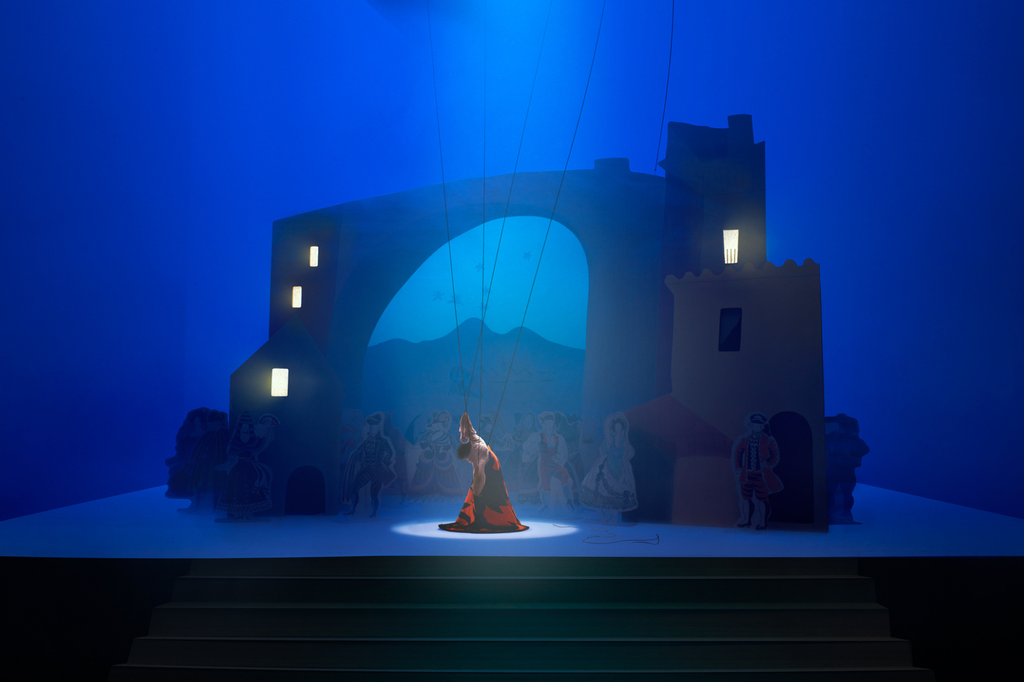
El Loco is a ballet in two parts, inspired by the artistic (and therefore existential) journey of Félix Fernández García (Seville, 1893 – Epson, Great Britain, 1941): a captivating and compelling legend in his own right: his (almost) religious passion for dance; his self-disembowelment, following in the footsteps of Diaghilev, Massine and the Ballets Russes, in London; his profound inner anguish at not taking part in the London premiere of El sombrero de tres picos; his flight, his madness, his death in obscurity at the Epson asylum.
An autobiographical fable that never existed: everything comes to us from Félix’s distorted memory; from the confusion of his fragmented, obsessive recollections; from his schizophrenic view of a strange, hostile world.
But it is also a performance that goes far beyond personal history and hagiography, becoming a vivid reflection on the artist and their demons, on the artist’s clashes with objective reality, and on the eternal mismatch between desire and reality.
And, above all, a dance performance that takes dance as the theme and central focus of its narrative.
On madness
a.
Some meanings of the word
‘Madness’: The quality or condition of the madman.
‘Madman’: One whose judgement or capacity for reason is impaired. One who feels extraordinary love or passion (for someone or something).
‘Madly’: Very much.
b.
Madness as an inheritance, as a pathology.
The Madman’s Mother, who laughs and laughs: at home, in the fields, in the asylum.
Félix dancing in front of the altar, at Saint-Martin-in-the-Fields.
A police report is drawn up. Name?: Félix Fernández García. Occupation: Musician and dancer. Diagnosis: catatonic schizophrenia. Admission: Long Grove Hospital, Epson.
c.
The artist’s madness: art as an act of creative alienation. Dance: a Dionysian, demonic impulse; a unique, overwhelming, all-consuming passion for life.
d.
Madness, the result of the eternal dialectic of man, of the artist: the conflict between reality and desire. Reality transformed, in the yearning mind of the artist: they are giants, not windmills. The misfit, the apocalyptic Félix; lost in an immensely vast world. In his suitcase made of planks, a farruca.
The madness of the Madman before his mirror: the acceptance of his true limits, of his real stature as an artist. The metronome can be a whip that lashes out, mercilessly, at failure.
e.
Madness as a vital escape: to survive life through madness.
Paco López
Playwright
In Praise of Madness
Madness, in the right measure, is an essential prerequisite for engaging in any artistic activity; all the more so in a world and a society such as ours today, where culture ranks last on the scale of political, economic and social priorities.
If we also bear in mind that dance is at the bottom of the list of cultural priorities, we might conclude that those of us who devote ourselves to this activity must be verging on catatonic schizophrenia, like Félix. Perhaps that is why, when one is presented with a project about madness, one feels right at home.
Very little has been written about Félix, and there are various accounts of what actually happened to him. What might initially seem like a hindrance when creating the work has, in the end, allowed the imagination to run wild and ensured that the result is not bound by historical specifics or fleeting comparisons.
"We have created a work that is, above all, romantic: a love story between man and dance.
We have let out a desperate and passionate cry in an age of few passions and many empty cries."
Eighteen years have passed since I wrote these words, which for me remain as true as ever, but the ‘El Loco’ we have staged this second time is very different from what it was, and it has evolved – I hope for the better – just as all of us involved in this creation have, to which we have sought to add these 18 years of experience, life lessons and technical and artistic knowledge.
I believe that the “El Loco” you are about to see has not undergone changes, but has rather embraced them.
Thanks to Paco López, my artistic partner of sorts, for his magnificent script and stage direction. It is always a pleasure working with you.
Thanks to Manuel de Falla and Pablo Picasso, wherever they may be.
Thanks to Mauricio Sotelo for capturing madness on the stave with such sanity.
Thank you to Cañizares for seamlessly blending 19th-century flamenco with that of the 21st century.
Thank you to Jesús Ruiz for enveloping it all in such beauty.
Thank you to Nicolás Fischtel for ‘illuminating’ us, almost mystically.
Thank you to Maribel Gallardo and the rehearsal assistants from the National Ballet for their impressive restoration work.
Thank you to the entire technical team for their dedication.
Thank you to the dancers and musicians who have poured out passion, skill and effort, and who are now “my children”.
And above all, thank you to Rubén Olmo for making this privilege possible, this dream come true.
I hope you enjoy watching the performance as much as I have enjoyed the process of creating it.
Javier Latorre
Dancer, teacher and choreographer
This ballet is inspired by the artistic and existential twists of fate in the life of the bailaor Félix ‘El loco’ Fernández – and the inner anguish he suffers after following Diaghilev, Massine and the Russian Ballets to London for the premiere of El sombrero de tres picos. A dance performance about dance. A modern-day reflection on the artist and his demons. A vivid ode to madness.
Original concept, libretto and stage direction by Paco López
Choreography by Javier Latorre
Music by Manuel de Falla, Mauricio Sotelo and Juan Manuel Cañizares
Musical direction by Manuel Coves
Set and costume design by Jesús Ruiz
Lighting design by Nicolás Fischtel (AAI)
Set construction: Ferrán Decoración, Spechio Piuma,
Iberia Inkyet, Peroni, Pinto’s and May Servicios para Espectaculos, SL
Costume construction: Ana Lacoma, Josep Ahumada, Gonzalez, Maty and Adame
Footwear: Gallardo
Orquesta de la Comunidad de Madrid (ORCAM)
Flamenco musicians from the BNE
Guest musicians: Juan M. Jiménez (saxophone), Agustín Diassera (percussion), Juan José Amador “El Perre” (flamenco singer)
Music editor:
Mauricio Sotelo, El loco. © Proyecto Sotelo.
Manuel de Falla, El sombrero de tres picos. © Chester Music.
Pozuelo de Alarcón Teatro Mira
Pozuelo de Alarcón Teatro Mira
Madrid Teatro de la Zarzuela
Madrid Teatro de la Zarzuela
Madrid Teatro de la Zarzuela
Madrid Teatro de la Zarzuela
Madrid Teatro de la Zarzuela
Madrid Teatro de la Zarzuela
Madrid Teatro de la Zarzuela
Madrid Teatro de la Zarzuela
Madrid Teatro de la Zarzuela
Madrid Teatro de la Zarzuela
Jerez de la Frontera Teatro Villamarta
Córdoba Gran Teatro