Select your language

Saltar al contingut Saltar a la navegació Informació de contacte
Invocación
Hong - Kong 54 HK Arts Festival
Hong - Kong 54 HK Arts Festival
The first programme designed by Rubén Olmo as director of the Ballet Nacional de España offers a comprehensive overview of Spanish Dance, covering most of its styles, from the bolero school to stylised dance and stylised flamenco.
It also includes a special tribute to the dancer and choreographer Mario Maya (1937–2008), one of the great masters of Spanish Dance, who, despite being one of the founders of Flamenco Teatro Andaluz with his own unique style, had not until now been included in the repertoire of the Ballet Nacional de España.
MUSIC AND CHOREOGRAPHY
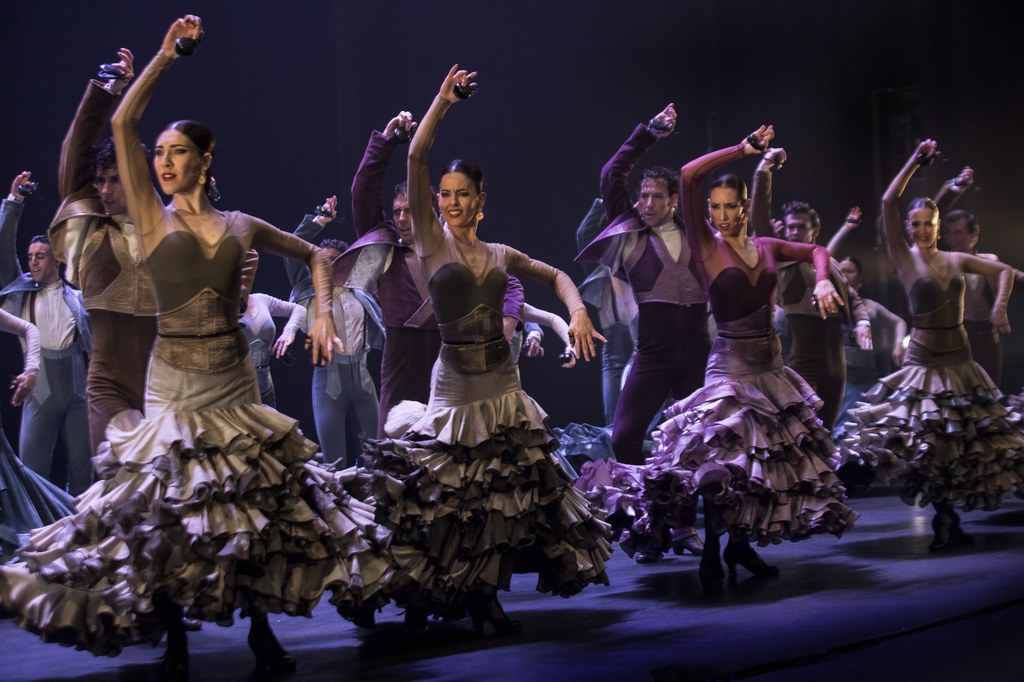
It is a newly created choreography by Rubén Olmo. Apart from being one of the few recent compositions in this style, it is also a tribute to the great masters who set down the guidelines to be followed in Escuela Bolera, from Ángel Pericet to Mariemma or Antonio el Bailarín.
Invocación bolera updates the essence of the traditional escuela bolera. It emerged in Spain in the 18th century out of the combination of Andalusian popular dances and academic dances. It is one of the most distinctive, complex, and unique styles of Spanish dance, characterized by the use of castanets.
The music is also a contemporary original composition specific for this piece, a commission from the Ballet Nacional de España to the young Sevillian composer and conductor Manuel Busto.
COSTUMES
The costumes for Invocación bolera are a handmade work of art that is rich and complex because of the handcrafted laces, embroideries, and thread work. The design is by Pedro Moreno, who created them for José Antonio Ruiz’s choreography Fandango del Padre Soler, premiered by the Ballet Nacional de España in 1988. Pedro Soler was also tasked with adapting the designs for Invocación bolera.
“Jauleña is a choreography that I created as a transition solo. I based myself on a village in Granada that brings together three cultures: Christian, Jewish and Arab. In this solo I combine three disciplines of Spanish dance: stylised dance, escuela bolera, and flamenco”.
Rubén Olmo
Jauleña is a bridge between escuela bolera, stylised dance, and flamenco. A solo inspired by Granada, performed by Rubén Olmo, where the granaína and zapateado styles take centre stage.
"Our intention with Dualia was to deal with Spanish dance and breath in the youth and freshness of this generation with such a rich repertoire, reflecting ourselves in the colours of Sorolla’s paintings, seeking the complicity of pair dancing, interpreting the sensuality of looks, caresses, kisses, reminding ourselves of the great dancers our country has produced, to try to portray our meaning and feeling through the rasping of the castanets.
Thank you José Antonio, we hold your air within, this one is for you, maestro."
Rojas and Rodríguez
The Ballet Nacional de España wishes to pay tribute to dancer and choreographer Mario Maya (1937-2008), one of the great masters of Spanish dance, who despite being a creator of a unique style of his own had not been included in our repertoire.
“Questioning traditional thought is always the starting point to gain new knowledge. Cultural tradition has to persevere in a vigorous, constant process to keep its status of ‘art’ and adapt it to the new social needs and conditions. Deep socioeconomic and cultural changes encourage me to seek new forms of expression as the only way to avoid the decay into folklore merchandise. Art is no ritualised memory. Art is a conception of life and a symbolic challenge to man. “Beat plus shout or shouting on beat”.
MARIO MAYA
The Ballet Nacional de España pays tribute to Mario Maya, a brilliant bailaor, choreographer, and master who passed away in 2008. Mario Maya is a leading figure in the world of Spanish dance because of his genius and sensitivity. A groundbreaking artist, he staged bold productions and created an artistic school that includes registros of dancer and bailaor at the same time.
De lo flamenco is defined as a flamenco suite that portrays Mario Maya’s own style, who in 1994 founded the Compañía Andaluza de Danza, present-day Ballet Flamenco de Andalucía. The programme Mario Maya premiered that year was a leap forward, a breath of fresh air that was different from the flamenco performed up till then. Even now it is still innovative and completely different from anything else.
“Master Mario was a tireless researcher in everything to do with this art, a global and Flamenco Teatro Andaluz leading dancer, creator of a unique, very personal style. That’s why, I believe that the Ballet Nacional de España had to include one of his works in its repertoire”
RUBÉN OLMO
"The Ballet Nacional de España is always a spectacular sight. Its exquisite, fluid transitions and the choreographic artistry of its dancers evoke the classic imagery of such companies, which throughout history have served as a model of artistic expression"
"Mario Maya may well have once dreamed of directing the BNE, but wherever he is now, he would surely be pleased that it was Rubén Olmo who chose to revisit one of his plays"
"A host of complex, brilliant choreographies, featuring a literally countless number of performers, impeccable discipline, and the rhythm of the soleá like a heartbeat"
"The BNE demonstrates its versatility not only across different styles—such as bolero, ballet and flamenco—but also in its ability to interpret three very distinct choreographic worlds"
"The Ballet Nacional de España, under the expert direction of Rubén Olmo, has demonstrated ambition and impeccable technical execution in this fascinating blend of the disciplines that make up Spanish dance"
Hong - Kong 54 HK Arts Festival Gran Teatro. Hong Kong Art Center
Hong - Kong 54 HK Arts Festival Gran Teatro. Hong Kong Art Center