Select your language

Saltar al contingut Saltar a la navegació Informació de contacte
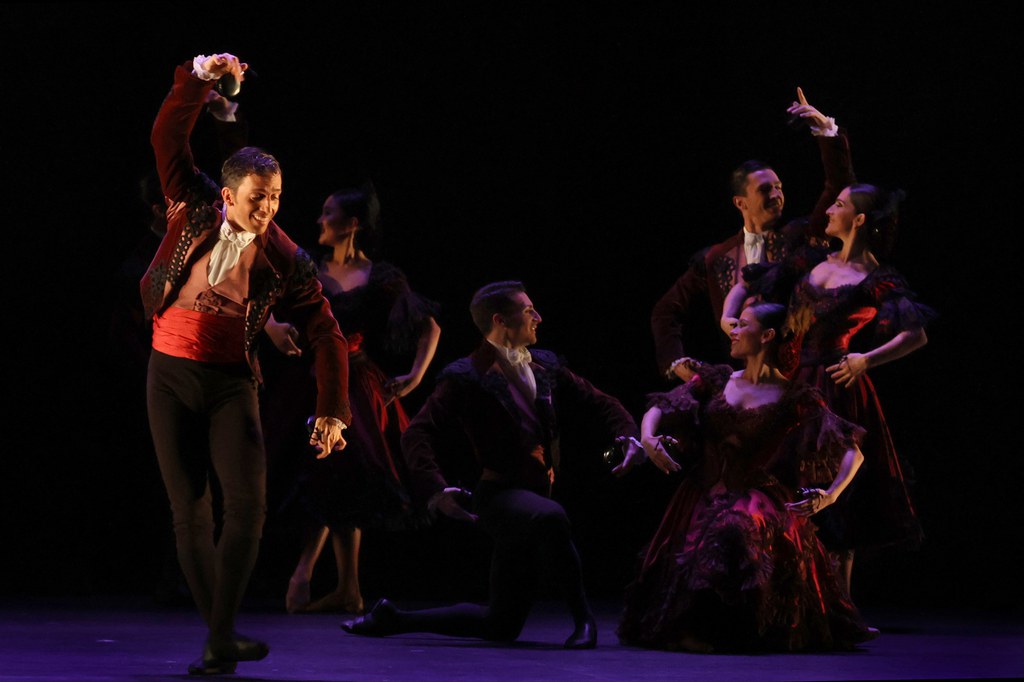
On March 25th and 26th, the Ballet Nacional de España will offer a global vision of the stylistic diversity of Spanish dance at the Teatro José Mª Rodero in Torrejón de Ardoz, Madrid. More than 40 dancers and the Ballet Nacional de España’s flamenco ensemble of musicians and cantaores will perform the quadruple program 'Invocación'. “It is a very complete program in which audiences can enjoy flamenco full of life and strength on stage, a ballet of the purest stylized dance, and one of the few recent choreographies in the escuela bolera style,” says Rubén Olmo, director of the Ballet Nacional de España.
The program begins with the escuela bolera choreography Invocación bolera, by Rubén Olmo. “It seemed important to me that the Ballet Nacional de España should have an ensemble choreography in the escuela bolera style, because there is only one in the repertoire, Danza y tronío, by Mariemma, while the rest are choreographies for one or two dancers,” adds Rubén Olmo. “To create Invocación bolera, I drew on the masters of escuela bolera and on what my own teachers taught me, but the result is a very personal escuela bolera choreography with a contemporary style,” he says.
The music for Invocación bolera is an original contemporary composition commissioned by the Ballet Nacional de España from the young Sevillian composer and conductor Manuel Busto. The costumes were designed by Pedro Moreno for the work Fandango del Padre Soler, premiered by the Ballet Nacional de España in 1988, and have been adapted by the designer himself for this piece.
Both creators also sign the next piece in the program, Jauleña, a transitional solo that explores how far the fusion of contemporary dance, stylized dance and flamenco can go. Musically, flamenco is the seed of a piece that can be divided into two parts: a granaína, in which the cello is the soloist, and a zapateado, where flamenco guitars and percussion form part of the orchestra.
The stylized dance, or classical Spanish dance, piece included in this program is Eterna Iberia, one of the purest ballets within this style, choreographed by Antonio Najarro for the Ballet Nacional de España in 2019. The cape and Cordovan hat, enhanced by the costumes designed by Yaiza Pinillos, take center stage in this ballet. The music was composed by Manuel Moreno-Buendía for Eterna Castilla, a ballet by Antonio Ruiz Soler premiered in 1963, and later published as a suite under the title Celtiberia.
The musical recording that will be heard at the Teatro Bretón in these three choreographies is performed by the Orquesta de Extremadura under the direction of Manuel Coves.
Tribute to a great creator of flamenco theatre
The second part of the program pays tribute to Mario Maya, an artist who changed the aesthetics and concept of flamenco, and a pioneer in telling stories and portraying the Andalusian people through movement. He sought to enhance choreography through dramaturgy, music and costumes, without losing sight of feeling.
To remember the Granada-born dancer and choreographer, who died in 2008, Rubén Olmo decided to restage De lo flamenco as faithfully as possible, the flamenco suite premiered by the Andalusian Dance Company — now the Ballet Flamenco de Andalucía — in 1994. According to the director, it is one of the freshest ballets created by Mario Maya and presents a very broad range of flamenco registers, from classicism to baroque richness and the avant-garde.
“I think Mario Maya would be very pleased to see his work within the Ballet Nacional de España, the company he dreamed of directing,” explains Rubén Olmo, director of the Ballet Nacional de España. “His repertoire fits very well with the Ballet because he choreographed for large groups of dancers.”
The production presented by the Ballet Nacional de España differs from the original, signed by Mario Maya, Milagros Menjíbar and A. Rueda “Toná”, in two choreographies commissioned from Isabel Bayón and Rafaela Carrasco. The former, who was principal dancer in Mario Maya’s company, has created the choreography Taranto. Rafaela Carrasco, for her part, signs Romance del emplazado, based on verses by García Lorca, following the essence and manner of the master in the soleá of the same title that Mario Maya choreographed especially for Israel Galván.
The Ballet Nacional de España’s flamenco ensemble, accompanied by three guest cantaores, will perform live the music composed by Diego Carrasco, Jesús Torres, Moraíto Chico and Los del Río.
Invocación was the first program premiered by the Ballet Nacional de España under the direction of Rubén Olmo. After closing the Festival de Jerez on April 7th, 2020, it has been performed on stages in Madrid, Dubai, Saint Petersburg, Santander, Pamplona, Zaragoza, Terrassa, Pozuelo de Alarcón, Albacete and Logroño. After Torrejón de Ardoz, it will travel to Valencia from April 21st to 24th, Toledo on May 8h, and Granada on June 17th and 18th.
Invocación
Ballet Nacional de España
Program:
Invocación bolera, by Rubén Olmo
Jauleña, by Rubén Olmo
Eterna Iberia, by Antonio Najarro
De lo flamenco. Tribute to Mario Maya, by Mario Maya, Milagros Menjíbar, A. Rueda “Toná”, Manolo Marín, Isabel Bayón and Rafaela Carrasco.
Teatro José Mª Rodero, Torrejón de Ardoz, Madrid
March 25th and 26th, 2022, 8:00 p.m.