Select your language

Saltar al contingut Saltar a la navegació Informació de contacte
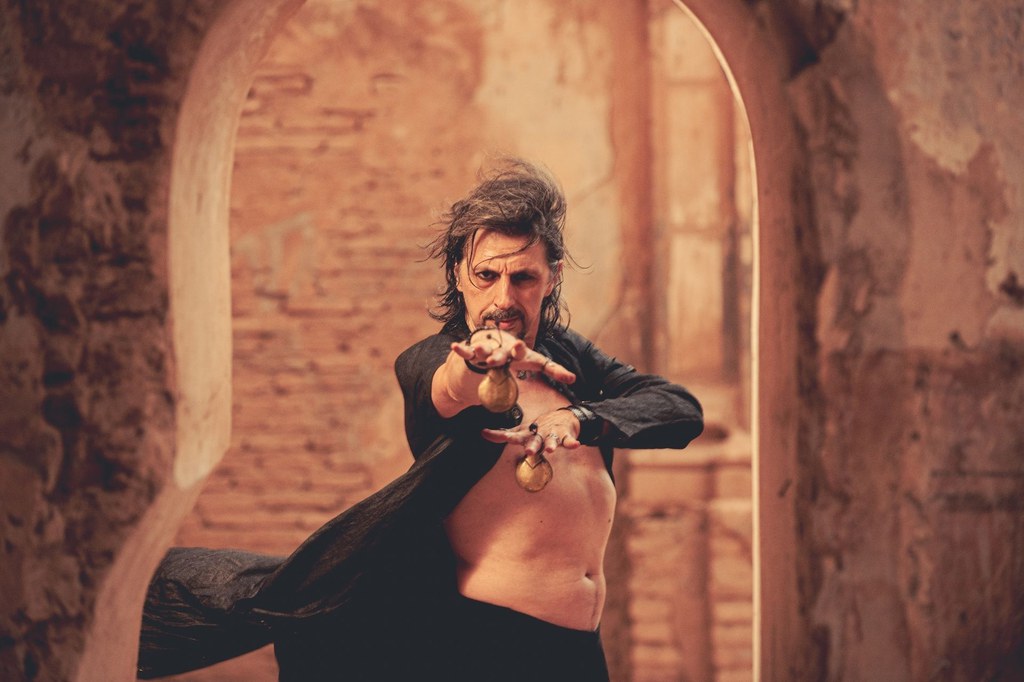
Nothing defines him better than 'Berna se escribe con jota', the title of one of the works by Aragonese dancer and choreographer Miguel Ángel Berna. He began dancing this traditional form at the age of eight and, although he has trained in other disciplines such as classical dance, contemporary dance and flamenco, the jota remains at the heart of his work, both in the projects developed with his company Danza Viva and in those created with other artists. From November 17th to 19th, 2021, he will share with the dancers of the Ballet Nacional de España the essence of his choreographic language and his work to include the jota in new stage creations, in one of the #BNEenMovimientoPerpetuo workshops scheduled this November on the updating of traditional dances.
How have you planned the workshop with the dancers of the Ballet Nacional de España?
The workshop is divided into three parts. The first is a review of the traditional steps of the Aragonese jota and their technical evolution as a foundation to be manipulated within my choreographic language. Then, we will build sequences of steps for the choreographic staging of La Templanza. This choreography, which has evolved over the years since it won first prize at the 9th Spanish Dance and Flamenco Choreography Competition in 2000, brings together the full essence of the development of my choreographic language. Musical work to adapt the original music to the choreography has also been a constant throughout my career. Finally, we will develop castanet technique in its traditional form, using the middle finger, and compare it with the use of castanets in Spanish dance, using the thumb. My entire career has been in constant evolution through this instrument, which is so important to Spanish dance.
What is the idea you intend to convey to them?
The fundamental aim is to analyse and reflect on how to use traditional dances and their capacity to adapt to the society in which we live. One of the most important ideas I want to convey concerns the importance of the evolution of traditional dance so that it can become a choreographic instrument capable of tackling major works and bringing them to the stage. This is one of the reasons why the choreographic evolution of traditional dance is necessary, beyond the repertoires of folklore groups, so that it can position itself on the international dance scene, just as flamenco has done.
Is the jota the best-known Spanish folk dance outside Spain? How would you define it in order to distinguish it from other popular dances?
The jota is known in some parts of South America, mainly because of the artistic journey it took in places such as Argentina, where renowned artists made it known during their tours, as well as through folklore groups linked to the different Aragonese associations around the world. These, as we know, proliferated from the mid-20th century onwards and are still responsible today for disseminating the jota. Apart from these places, and from my experience abroad, I can say that the jota is not particularly well known, nor is it the most widely disseminated. I define it as a common language shared by all Spaniards, which has developed unique and specific characteristics in the different autonomous communities.
What are the similarities and differences between the jotas of the different regions of Spain?
In their popular language, the differences lie in the geographical and climatic particularities that have influenced the way the dance is performed, as well as its social functions. However, the differences and similarities in the stage jota lie more in its technical evolution.
Is there a generational renewal in the jota, or in folklore in general?
In Aragon, there is no generational renewal as far as the popular jota is concerned, due to the loss of its social relevance. There is still a great deal of work to be done to revalue this intangible heritage. As for the stage jota, there is generational renewal linked to the teaching carried out in the schools of folklore groups. However, there is still much to be done regarding new creations for the performing arts, as has happened with flamenco.
Is the dance performed on stage the same as the one danced in a village square?
No. The moment you take popular dance out of its social context and its community function, it becomes something else; it becomes a show, or better still, art. This is a subject that would need to be addressed at length and from an anthropological perspective.
Can the jota evolve, or must it be preserved so that it does not disappear because it is an endangered heritage?
The stage jota necessarily has to evolve. The popular jota evolves by itself as long as it remains alive in society.
Can a jota express anything, or is it a language with a register limited to tradition?
Is tradition limited? Or, because it is tradition, are there things it cannot tell? Great works were written in antiquity that were inspired by popular traditions and customs.
In your latest show, you bring together the jota and the Italian taranta. Do you also find similarities or complementarities with other dances? Do you think a fusion jota is possible? With what other type of dance would it be easiest to fuse it?
On many occasions, my proposals have been interpreted as a fusion with other languages. However, my purpose has been to seek the cultural links that my tradition has at some point shared with other lands. With the Italian taranta, it is clear that my search has followed the ancient legacy of the Crown of Aragon; and there is still much to investigate regarding the relationship between the jota and the tarantella, because they share a popular language that may have a common origin. Thus, looking back at the past and at all the shows I have created, I have tried to connect my language — which has evolved into a genre of its own — starting from the tradition of my land and finding other cultures that Aragon once shared.
As for fusion itself, I believe that all popular dances are the result of one fusion after another which, over time, have settled in each place and acquired specific characteristics.