Select your language

Saltar al contingut Saltar a la navegació Informació de contacte
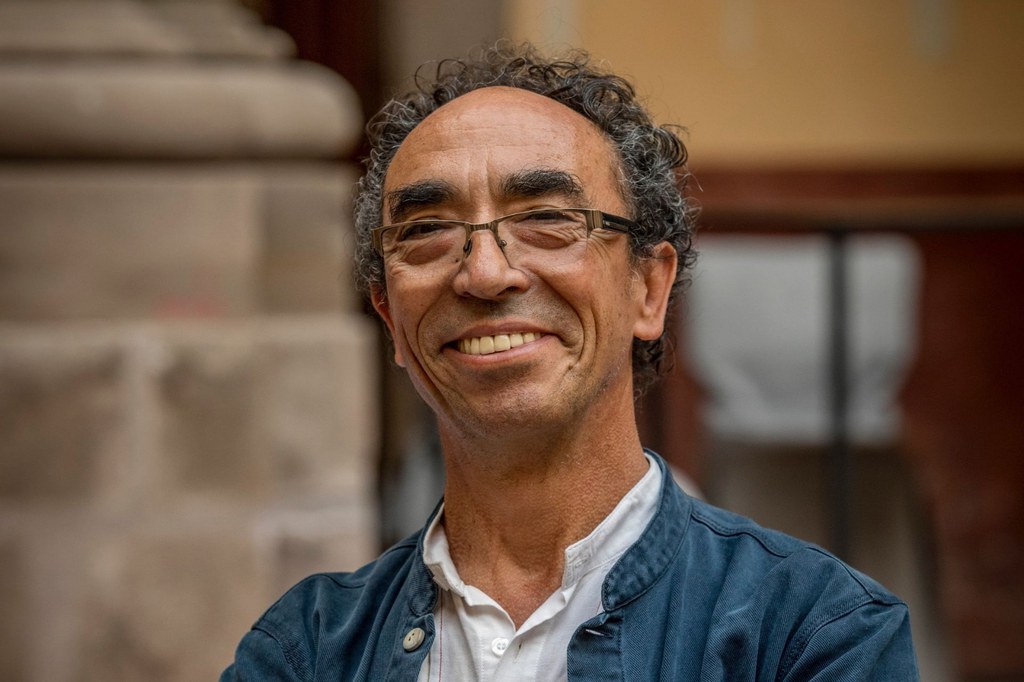
Choreographer, dancer and director of the company Ibérica de Danza Manuel Segovia will lead the first of the #BNEenMovimientoPerpetuo choreography workshops devoted to updated folklore from November 3rd to 5th, 2021. Winner of the 2001 National Dance Award for Creation, he has a multifaceted training background — studying music, classical guitar, traditional dance, classical ballet, flamenco and Spanish dance at the Ballet Nacional de España School, among other centres — and a wide-ranging career that began at the Teatro de la Zarzuela and has developed in the field of reworked folklore, leading him to create his own authorial language based on traditional Spanish dance.
In your opinion, is folklore a cultural heritage that must be preserved, or is it another language or technique of expression within dance?
Folklore is the expression of the people, their knowledge and experiences, that with which they identify, the essences that arise from the wisdom of our forebears and, without a doubt, our heritage: the legacy left to us by our masters, which we have a responsibility to pass on to future generations. It is true that all this traditional culture — games, dances, music, songs, traditions — has gradually been lost in this depopulated Spain. Some traditions lost their meaning years ago because they were linked to ritual actions or festivals that are no longer celebrated; that does not mean they are dead, but it is also true that, increasingly, part of this folklore emerges as a representation of a longed-for past.
Respecting all the currents of opinion that exist at present in the world of folklore, from the most orthodox and conservative to the revisionist — all of them necessary for the preservation and good health of this rich legacy — it is nevertheless clear to everyone that, both in music and professional dance, we have been using folklore for years as an open code for authorial creation, as a source of inspiration. This is nothing new; Béla Bartók, one of the founders of ethnomusicology, already used it. The great maestro Antonio Ruiz Soler, a pillar of Spanish stage dance, is one of the finest examples with his Fantasía Galaica. For me, therefore, folklore is both things: a wonderful heritage, a legacy that we must transmit, and an open code for creation that drives me to explore new danced universes.
What is the renewal or updating of folklore like in your choreographies?
Going back to 1995, I discovered a musician who powerfully caught my attention and who would later become a great friend and mentor: Juan Alberto Arteche, one of the founders of Nuestro Pequeño Mundo, one of the pioneering folk groups in Spain since 1968. I was so interested in his way of composing and treating traditional music that I called him to collaborate on his work Campos de Sol y Luna, a musical gem. It had a singular and unique experimental musical architecture, while respecting the essence.
What his music awakened in me was the irresistible impulse to give movement to his work by applying and starting from that open code that folklore is for me: building and elaborating, with respect, those steps that my teachers had generously passed on to me, turning them into units of movement and naturally intertwining them with other movement techniques. In other words, aesthetically, organically and harmoniously, they corresponded to my concerns, and this offered me an immanent field in which to explore and, therefore, to create from emotion and not only from form. This choreographic work gave me the tools and the foundation, the key and the method, and it is, with variations, the basis of my creations and projects.
From this milestone onwards, the music and the musicians who began to rework and recreate folklore — Eliseo Parra, Javier Paxariño, La Musgaña, Eduardo Laguillo, Alexis Tobías and others — became part of my musical family and great friends with whom I have shared tours, journeys and many experiences. Without them, and without the dancers who unconditionally share each project, this adventure would have been impossible.
This perception of folklore allows, in this case, the licence to call it “neo-folk”, since, like the music created along these lines, it is also authorial dance. We are continuers of the choreographic legacy of Spanish stage dance and, in some way, we contribute through our own perception to the dissemination of our rich heritage in the present.
Is there a difference between Spanish dance and Spanish stage dance?
In an open debate in which I took part, someone said that the term “Spanish dance” was so generic that it could refer to any type of dance made in Spain. That made me reflect, and it is why, personally, I prefer to say Spanish stage dance. This term includes the different styles of Spanish dance — folklore, escuela bolera, stylized dance and flamenco — understood from a stage perspective. It is not only choreographic design; it is also lighting, set design, costumes, dramaturgy… I believe all of this defines the choreographic art of this wonderful genre a little better. In any case, it is an open debate, and I encourage professionals to take part in it.
How do you see the state of health of folklore in Spain, based on your experience researching traditional dances?
In my opinion, our folklore and its history are full of paradoxes. In its initial proposal, folklore sought to gain recognition from science, but we have to acknowledge that today the word folklore is used to define something lacking value and even something denigrating.
My dear teacher Juanjo Linares promoted, developed and worked on proposals to bring traditional dance and music into the university, and I myself have participated in committees alongside folklore associations to build a taxonomy of our dances.
Folklore is something that should be present not only at university, but also in school and secondary-school curricula. However, I have the impression that there is not much interest from some institutions; it seems that popular knowledge is not of interest.
Nevertheless, I must say that there are families and associations that cultivate the foundations of folklore and its different currents in schools and amateur groups with truly enviable dedication and passion. We could say that, in those environments, it enjoys good health, which is another paradox within its ongoing present.
Are we experiencing a renewal of folklore, or is it a minority movement?
I like to say that our followers are a “majority minority” movement; that is, it is not yet a movement that draws the attention of large masses, but it does have enough followers for us to keep working with enthusiasm.
At the moment, more and more choreographic talents are emerging who are interested in new folklore and are doing magnificent work, and more will undoubtedly continue to appear. I am optimistic in this regard.
How do you get along with staunch defenders of tradition?
I have great friends who defend points of view different from mine, and I occasionally collaborate with them in workshops for groups where we debate with mutual respect and all learn together. We get along very well, in fact.
What has been the evolution of the company Ibérica de Danza, which you created with Violeta Ruiz in 1993?
If I had to make a retrospective assessment of our company, we would have to take into account at least three paths: creation, funding and training. The first offers a very satisfying balance, with institutional and sector recognition such as the National Dance Award for Creation and the Villa de Madrid Choreography Award, as well as more than 30 productions and tours to more than 20 countries, in addition to collaborations in major projects such as Wrocław, European Capital of Culture 2016, and our participation as organizers in the Ibérica Contemporánea Festival in Mexico since its creation in 2007.
The second path is more arduous and complicated. We can say that funding is what any company in the performing arts sector in our country faces; in the case of dance, it is even a little more complex and involves a constant struggle. In order to have dialogue with institutions, we professionals had to establish the Association of Dance Professionals, Emprendo Danza for companies and ensembles, and the business federation FECED. We deal with different fronts in the value chain of a production: technology, financing, distribution, communication… and we do not always obtain the results we would like. Maintaining a large-format company like ours — we have had as many as 30 people on tour — is truly a daily challenge.
The third path, running in parallel, is that of training new dancers and new audiences. But we do not complain; we are warriors and we will keep fighting so that our society appreciates Spanish stage dance as art and enjoyment, and so that citizens come to include it among their interests.
Although institutions should help more in this regard, the Academy for the Dissemination of Spanish Dance, which I chair, prepared a report more than five years ago requesting that Spanish dance be declared an Asset of Cultural Interest, and we are still waiting for a response from the Ministry of Culture. If the institutions themselves do not support us, it is difficult to move forward. That said, my personal assessment is positive, because I am passionate about my work.
What path do you want to follow as a creator in the future?
Campos de Sol y Luna was my first creation using folklore as a first-generation open code. In Vértigo, our latest production, we are working on and exploring new paths to define what would be second-generation codes. My work as a creator in this ongoing present is to delve deeper into these codes, develop them and continue defining the method.
You are also the founder and artistic director of the music festivals Folkinvierno and MadridFolk, two of the more than 50 world music festivals held in Spain. Before the standstill caused by the pandemic, were these kinds of festivals going through a good period? Does this positive situation also extend to dance, or is it only true of music?
When we talk about folk music or new folk, we are talking about music for majority minorities, which normally filled venues, provided they were small or medium-sized halls. The pandemic has been a disaster for everyone in general, but for concerts, dance and the performing arts in particular, the closure of theatres was total.
There are some differences when we talk about concerts and dance performances. Normally, a music group has unconditional followers who will attend the concert no matter what. In dance, that premise does not exist; there is a lack of enthusiasm, of followers who attend the shows of this or that company, of unconditional dance-loving audiences who enjoy a quality dance performance. Although I should point out that when spectators who have never seen a dance show come to see us, they come back. They are really parallel worlds, close to each other, but not always united. In both Folkinvierno and MadridFolk, I have managed to connect these two worlds, and it is truly exciting to see how lovers of music and followers of groups also become lovers and followers of dance.
How are you going to work on this choreography workshop with the dancers of the Ballet Nacional de España?
The idea is to approach the rhythms and the baile charro. Based on the choreographic structure of the Suite del Rebollar, we will create an authorial piece with a new architecture, using different techniques and processing the movements through a fusion of styles and genres. It is therefore an eclectic piece in its essence, starting from units of movement from our folklore in order to reinterpret them.
We will work on the origins of the pieces, analyse the steps and recreate open-code combinations and movement design in a stage space. These axes allow us to generate an imaginary folklore, or neo-folk, from the reinterpreted steps of our traditional dances, which also provide us with an open-code emotional space, free from borders and stereotyped limitations.
What is the main idea you want to convey?
What we will work on and develop in our workshop is authorial choreographic language based on units of movement and sequences that come from traditional dance and their personal reinterpretation. We will get to know their essence, style and structure, seeking quality of movement as well as content, with energetic and emotional supports. The aim is for the dancers to become aware of the importance of traditional dance, its capacity for renewal and projection in the construction of new choreographies, and the possibilities it offers to performers and creators linked to Spanish stage dance.