Select your language

Saltar al contingut Saltar a la navegació Informació de contacte
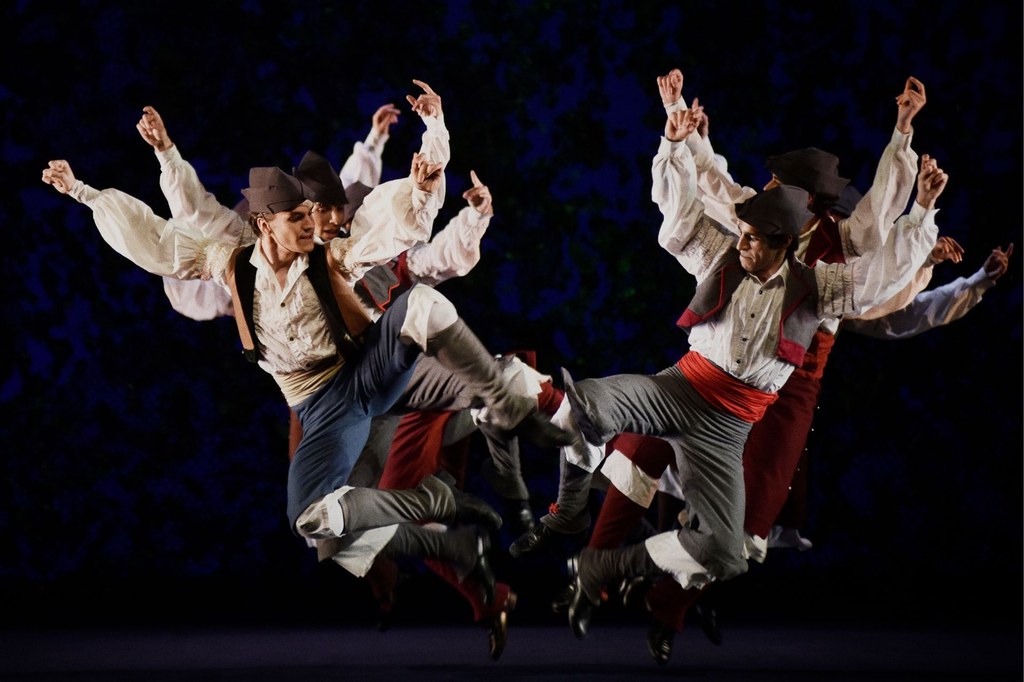
On November 4th, 2021, Antonio Ruiz Soler, better known as Antonio el Bailarín, would have turned 100. To commemorate the figure of the dancer, choreographer, and director who most profoundly shaped the evolution of Spanish dance — and whose death also marks its 25th anniversary — the Ballet Nacional de España, directed by Rubén Olmo, has prepared a program bringing together four choreographies that represent the height of Antonio’s talent and two others that follow in the path marked by his style.
The only performance of Centenary Antonio Ruiz Soler that the Ballet Nacional de España will give on October 7th at the Víctor Villegas Auditorium in Murcia opens the 2021/2022 season. The music, composed by Ernesto Halffter, Isaac Albéniz, Pablo Sarasate, and Father Soler, among others, will be performed live by the Symphony Orchestra of the Region of Murcia, conducted by Manuel Coves.
“Antonio renewed the way of dancing and further enhanced Spanish dance, as well as being the most complete dancer, choreographer, and director in history. He mastered every discipline and created wonderful productions of folklore, stylized dance, escuela bolera, and flamenco. He performed in and choreographed films both in Spain and in Hollywood. He was a genius and one of the dance figures in Spain gifted with a special charisma. Antonio was unique”, says Rubén Olmo.
Premiered at the Teatro de la Maestranza in Seville on April 15th, the selected choreographies by the former director of the Ballet Nacional de España between 1980 and 1983 are Sonatas, Zapateado, Fantasía Galaica, and Vito de Gracia. The first three represent the height of his talent in three different styles: escuela bolera, the stylization of flamenco, and stylized folklore, while the last is a pas de deux that Antonio performed with Rosario in the film Hollywood Canteen in 1944.
For Rubén Olmo, Sonatas reflects the influence of classical dance technique on Antonio’s style, as he created a classical ballet structure for this suite within a bolero-style choreography. The complete version of this work had not returned to the stage since its premiere at the Teatro de la Zarzuela in 1982 and the subsequent tour. “It seemed to me that it was too rich a work to remain in the trunk. Nor could we fail to include Zapateado. It is perhaps the stylized flamenco solo that brought Antonio Ruiz Soler the greatest success,” the director points out. “Fantasía Galaica is one of my favorite works by Antonio because I think it is perfectly rounded. No work like it has been created again”, he concludes.
The Ballet Nacional de España has tried to remain as faithful as possible to the first version of these works premiered by Antonio. To this end, the audiovisual archive has been studied, and the original costumes from his 1980s production — which Antonio donated to the Ballet Nacional de España and which the company has preserved ever since — have been recovered and adapted. For the set design, the company has commissioned audiovisual projections from artist and bailaor José Maldonado and reused scenic elements from other productions. The Teatro Real has lent the palace arches used in Sonatas, designed by Daniel Bianco for the production Las bodas de Fígaro.
What sets this program apart from previous tributes is that these key pieces from Antonio’s career are joined by creations inspired by his style: Estampas flamencas, by Rubén Olmo and Miguel Ángel Corbacho, and Leyenda “Asturias”, by Carlos Vilán. A collaborator of the maestro in the final years of his career, Vilán conceived Leyenda in 2016 especially for Esther Jurado, guest principal dancer of the Ballet Nacional de España, who now includes it in her repertoire. For its part, Estampas flamencas explores traditional flamenco from its origins, both in terms of costume and music, through the flamenco forms commonly found in Antonio’s work: zorongo, martinete, taranto, and caracoles. “Overall, it is a very complete program that will convince lovers of the most classical Spanish dance”, says Rubén Olmo.
Inclusive Spanish dance
As part of the educational activities that the Ballet Nacional de España carries out alongside its performances, last Monday, October 4th, it offered an educational workshop to a group of children from the Association for People with Down Syndrome of Murcia (ASSIDO), which is part of Plena inclusión Región de Murcia.
Dance is a proven therapeutic tool that fosters the development of social skills as well as physical, psychological, and cognitive abilities. The children attended the workshop Bailando un tesoro at the association’s headquarters in the Murcian district of Casillas, led by Maribel Gallardo and Belén Moreno. The two members of the BNE’s educational team introduced the children to Spanish dance through costumes, hand clapping, footwear, and castanets.