Select your language

Saltar al contingut Saltar a la navegació Informació de contacte
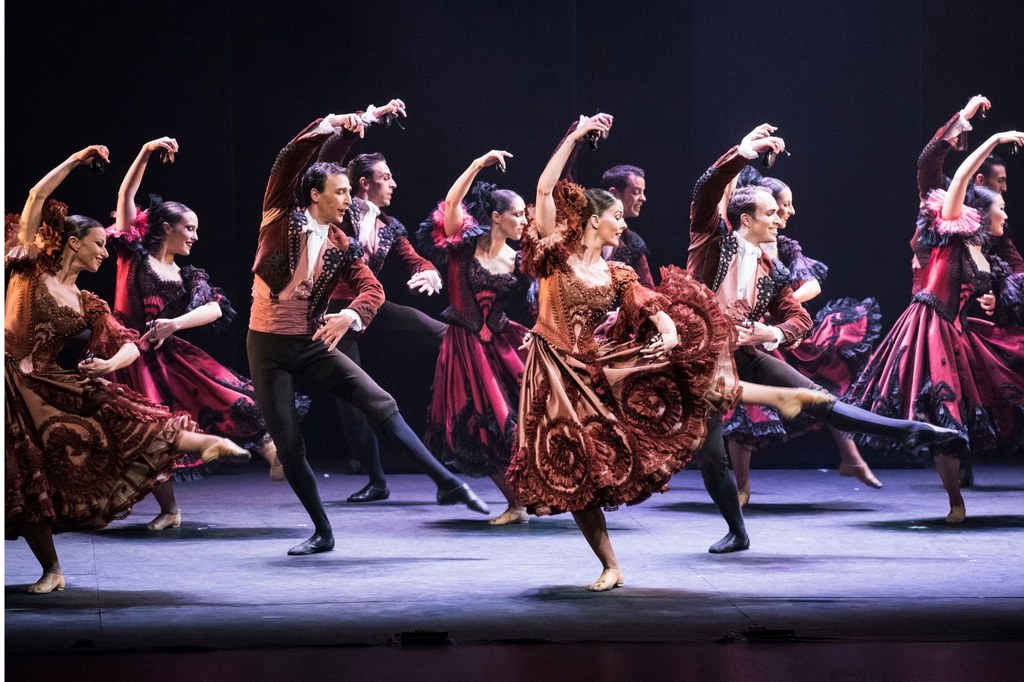
From April 21st to 24th, 2022, the Ballet Nacional de España, directed by Rubén Olmo, will open the dance season at Valencia’s Palau de les Arts Reina Sofía with a global vision of almost all styles of Spanish dance. 'Invocación', a quadruple program premiered in 2020, consists of choreographies by Rubén Olmo and Antonio Najarro, and includes a tribute to Mario Maya, one of the pioneers of flamenco theatre in Andalusia. The Orquestra de la Comunitat Valenciana, conducted by Manuel Busto, together with the BNE’s flamenco musicians and cantaores, will accompany the company’s more than 40 dancers live.
“It is a very complete program in which audiences can enjoy flamenco full of life and strength on stage, a ballet of the purest stylized dance, and one of the few recent choreographies in the escuela bolera style,” says the BNE director.
Invocación opens with the escuela bolera choreography Invocación bolera. This style is one of the most difficult disciplines in Spanish dance because of the speed of its steps and jumps, and the use of classical ballet steps together with castanets, or palillos. In this work, Rubén Olmo updates the essence of traditional escuela bolera, while also paying tribute to the great masters who marked the path to follow in this style.
The music for Invocación bolera is an original contemporary composition commissioned by the Ballet Nacional de España from the young Sevillian composer and conductor Manuel Busto, who later also took part in the collective score for La Bella Otero. The costumes were designed by Pedro Moreno for the work Fandango del Padre Soler, premiered by the Ballet Nacional de España in 1988, and have been adapted by the designer himself for this work.
The same creative duo, Rubén Olmo and Manuel Busto, is responsible for Jauleña, a solo that intertwines several dance styles, with particular prominence given to zapateado and granaína. In Valencia, Miguel Ángel Corbacho, assistant to the director, and José Manuel Benítez, soloist dancer, will alternate as performers on stage.
Eterna Iberia, by Antonio Najarro, completes the first part of the show. It is a stylized dance choreography, premiered by the Ballet Nacional de España in 2019, which uses traditional elements of Spanish dance such as the cape and the Cordovan hat. The music was originally composed by Manuel Moreno Buendía for Eterna Castilla, a ballet by Antonio Ruiz Soler, and later published as a suite under the title Celtiberia. Yaiza Pinillos’s sophisticated costumes represent the richness of our land through the use of blue, green and burgundy to symbolize three of our treasures: the sea, olive trees and wine.
Flamenco takes center stage in the second part of the Invocación program with the inclusion, for the first time in the Ballet Nacional de España’s repertoire, of a choreography by Mario Maya, a leading figure in Spanish dance thanks to his genius and sensitivity. Maya, who died in 2008, was a pioneer of flamenco theatre, the creator of bold and innovative productions, and one of the most tireless researchers of our time.
Rubén Olmo selected De lo flamenco because, in his view, this production by Mario Maya, premiered by the Andalusian Dance Company in 1994, refreshed the way flamenco was made and felt on stage through its stylization and movement, especially with a large company of dancers. “Even now, it remains innovative and completely different from the rest,” says Rubén Olmo.
The staging of De lo flamenco presented by the Ballet Nacional de España differs from the original by Mario Maya, Milagros Menjíbar, A. Rueda “Toná” and Manolo Marín in the two new choreographies created by two of Mario Maya’s regular collaborators: Romance del emplazado, by Rafaela Carrasco, and Taranto, by Isabel Bayón. Artists who were part of the original cast have also collaborated in this revival, from répétiteur Manuel Betanzos to musician Diego Carrasco, one of the songwriters, together with Jesús Torres, Moraíto Chico and Los del Río. The costumes are a replica of the originals designed by Mario Maya and have been hand-painted by Juan Andrés Amaya.
Coinciding with the Ballet Nacional de España’s performance in Valencia, a group of 25 children from the family prevention and strengthening program of Aldeas Infantiles SOS in Valencia will attend the educational workshop on April 20th in the Aula Magistral of the Palau de les Arts and, afterwards, the dress rehearsal of the show. This activity, included in the Palau de les Arts educational program Les Arts és Educació, will be led by first dancer Sergio García, répétiteur Maribel Gallardo, and Belén Moreno, head of the Educational Activities Department. The three members of the Ballet Nacional de España will introduce the children to Spanish dance through some of its most characteristic elements, such as the shawl, hand clapping, footwear and castanets. The activity is also supported by interactive educational materials published by the Ballet Nacional de España, including an illustrated book, three augmented-reality booklets and a video game.