Select your language

Saltar al contingut Saltar a la navegació Informació de contacte
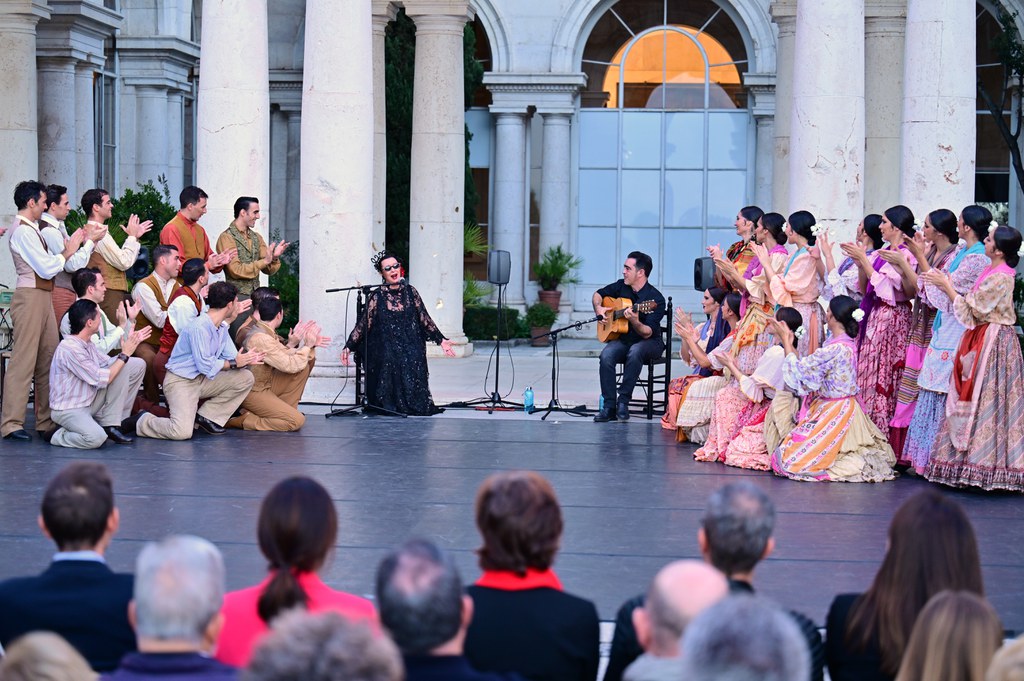
Ballet Nacional de España paid tribute to the Málaga-born artist with a performance in collaboration with Casa de Velázquez, the institution hosting the exhibition "Embrujo: Los mundos de Miguel de Molina" until October 27th. The immortal "Ojos Verdes", performed by Martirio and choreographed for the occasion by the Ballet's director, Rubén Olmo, closed the programme.
Ballet Nacional de España, directed by Rubén Olmo, paid tribute to the Málaga-born artist with a programme specially created for the occasion. The audience was able to enjoy two choreographies from the company's repertoire, Martinete and Caracoles, and a third, set to the music of Molina's immortal copla, Ojos Verdes. For the third choreography, the dancers were accompanied by Martirio's voice and Raúl Rodríguez's guitar, which helped bring the performance to a moving close.
For Alejandro Salade, director of the Fundación Miguel de Molina and the artist's great-nephew, this tribute is another milestone in the process of fully recovering a universal creator who shook the world of the stage and left us an important artistic legacy.
The event was organized by Ballet Nacional de España and Casa de Velázquez, the institution hosting the exhibition Embrujo: Los mundos de Miguel de Molina until 27th October. The exhibition is part of an international research project supported by the Casa de Velázquez, which studies the Málaga-born artist's work through his personal archive.
Nancy Berthier, director of Casa de Velázquez, has emphasised the need to foster this kind of transdisciplinary initiative, at the crossroads of creation and research, to achieve a better understanding of contemporary issues, as is the case with the memorial restoration of Miguel de Molina's legacy.
The legacy of the multi-faceted ‘King of the Copla’
This exhibition, which showcases part of Fundación Miguel de Molina’s archive, highlights lesser-known aspects of the popular singer with previously unpublished materials. Because Molina wasn't just a brilliant singer of copla. He began his career as a "gypsy art dancer" with Soledad Miralles without ever having set foot in a dance academy, yet Antonia Mercé "La Argentina" hired him to play “El Espectro” in her version of El Amor Brujo in 1934. Shortly afterwards, he was putting on his own shows accompanied by the comic actress Amalia de Isaura. It was then that Molina began to unleash his full genius: not only did he design and stitch the avant-garde costumes used in his performances, but he also choreographed, designed the sets, directed the scenes, and even arranged the musical numbers.
In this regard, Rubén Olmo, director of the BNE, highlights Molina's influence on the aesthetic renewal of Spanish copla, as someone who introduced avant-garde elements and approached staging in an integrated way, blending all the disciplines involved. This is the legacy that Ballet Nacional de España wanted to honour, a legacy that goes beyond the individual and reveals a creator who has undoubtedly left his mark on the performing arts in our country.