Select your language

Saltar al contingut Saltar a la navegació Informació de contacte
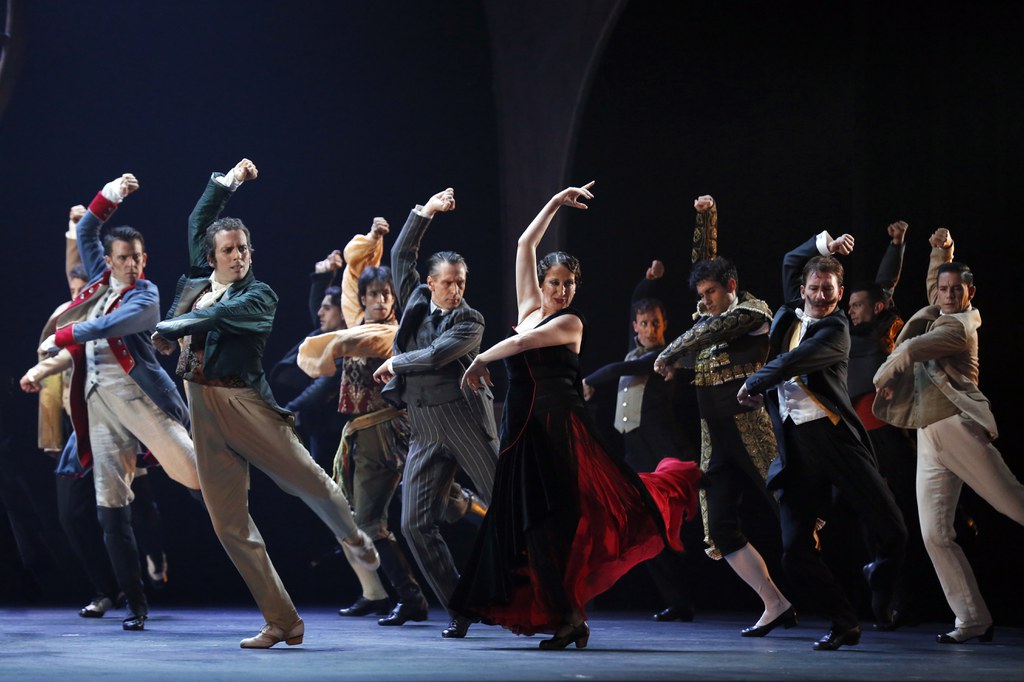
El Teatro Calderón hosts this show about the legendary dancer from February 7th to 9th, with tickets sold out. Choreographed by Rubén Olmo and premièring in 2021, it offers a journey through the main stages of her eventful life.
La Bella Otero premières tomorrow at the Teatro Calderón in the capital of Castilla y León after touring various cities both in Spain and abroad to excellent acclaim. Noelia Ruiz, a dancer with Ballet Nacional de España, will play the young Otero, while Maribel Gallardo, a special collaborator, will play the protagonist in her later years. The company, which last visited Valladolid in 2019, has nearly sold out its three-day run.
La Bella Otero is a large-scale show that transports viewers back in time to learn about the life experiences of the most desired dancer of the Belle Époque. Rubén Olmo, choreographer and current director of the company, allows dance to serve history to narrate the life of Carolina Otero, a woman who invented herself after a tragic childhood event and triumphed as an artist and courtesan, only to be ruined by gambling.
“Many years ago, before I'd even begun my career as a choreographer, I found some postcards of Bella Otero in a secondhand shop. When I discovered that one of the most famous women of her time was from a village in Pontevedra, I knew I had to create a ballet about her life. But I knew I needed the backing of a great company to be able to realise it as I imagined, as a large-scale show. Directing the Ballet Nacional de España has allowed me to make it a reality,” explains Rubén Olmo about the origin of his choreography.
A large production with well-known collaborators
With such a complex, large-scale production, Ballet Nacional de España has called upon renowned professionals in both the national and Europe-wide performing arts scene.
The plot is dramatised by actor and director Gregor Acuña-Pohl, who takes some of the most notable moments in the character's biography that could be expressed through dance – without trying to tell the story comprehensively. “I tried to stick to the historical figure and make it a ballet that would move the audience, without judging her. The most important thing for me was to show a person with great magnetism, charisma and strength.”
The music of La Bella Otero stands out for the great diversity of aesthetics that make up the score, although it is conceived as a large compositional unit. It combines everything from Galician folklore to aesthetics with experimental or avant-garde aspirations, from flamenco to current reinterpretations of styles and forms used in the Belle Époque. This diversity has been resolved through the creation of a collective work featuring three composers for the symphonic part: Manuel Busto, Alejandro Cruz and Agustín Diassera. Additionally, guitarists Diego Losada, Víctor Márquez, Enrique Bermúdez and Pau Vallet have added their own flamenco compositions; and the group Rarefolk has added ambience to the scene set in Galicia with their distinctive psychedelic Celtic rock. Conductor and composer Manuel Busto was responsible for bringing coherence to the whole piece: “My main challenge when developing the arrangements and orchestrations was to ensure they didn't lose any of the original's freshness and personality, but remained a natural part of the work.”
Along with creating such a complex and varied score, another challenge for this dramatic ballet was designing nearly 200 costumes to dress the dancers in periods and settings as diverse as a Galician village, Belle Époque Paris, and a café cantante. The centrepiece of the wardrobe, designed by Yaiza Pinillos, is the Byzantine-inspired beaded costume worn by Bella Otero in one of her most iconic portraits by Reutlinger. On top of the difficulty of designing a costume that reflects a period yet allows for easy dancing and changing between scenes there was also the use of wigs, beards, moustaches and hats. “The director, the technical team and I all agreed to embrace the challenge of representing the period, a challenge that the dancers also share, as they must undertake very complex changes of look that involve not only costumes but also makeup, on top of having to perform their dance steps with these costume elements and wigs.”
Eduardo Moreno, winner of the Max Award for Best Set Design in 2012 for Of Mice and Men, took on the challenge of designing a single architectural element that would help identify each scene temporally and geographically with a few simple additions. To achieve this, he devised a dome, which frames the entire performance and houses the different scenes. The lighting, designed by Juan Gómez-Cornejo, National Theatre Award winner, surrounds the dancers, adding an emotional element to each setting: "The light must accompany, envelop, assist, and, if possible, caress these dancers so that the story reaches the audience with the greatest clarity and the same emotion with which it was created."
La Bella Otero
BALLET NACIONAL DE ESPAÑA
Programme:
LA BELLA OTERO
Teatro Calderón
Valladolid
Friday 7th February 2025, at 19:30.
Saturday 8th February 2025, at 19:30.
Sunday 9th February 2025, at 19:30.